|
Vet
Legislation |
| UN-known
risks are UN-acceptable!
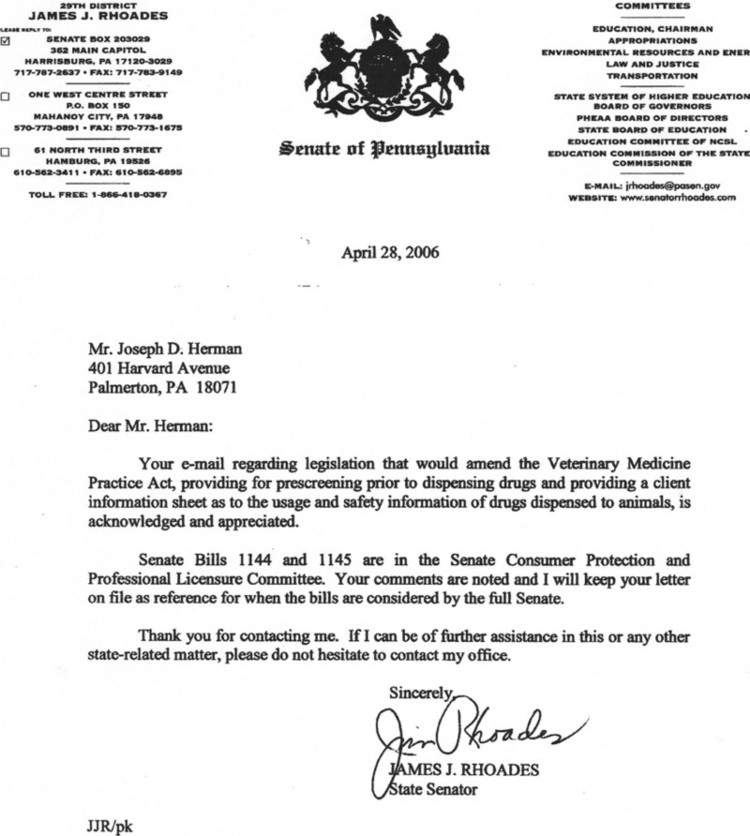
and in Pennsylvania there is new legislation for the well being of our companions, so we can be made aware of possible risks. It took some effort (letters and phone calls) and a lot of persistence With support from all of us, and effort and persistence, this can be put thru in every state! For further detailed information for the FDA docket or http://www.fda.gov/ohrms/dockets/dockets/04n0559/04N-0559_emc-.pdf |
Here is a link the members of the Consumer Protection
and Professional Licensure Committee: |
||||
 |
Letters
| Critter Fixer Pet Hospital Bob Rogers DVM 5703 Louetta Spring, Texas 77379 April, 24, 2006 Dear Senators, Representatives, and members of the Consumer Protection and Professional Licensure Committee: As both a pet owner and a Veterinarian, I am writing to strongly urge you to support both Senate Bill #1144 and Senate Bill #1145. In the last eight years thousands of dogs have died each year from the misuse of new arthritis medicines for dogs. About a third of the deaths are due to over-dosage by Veterinarians, about a third are from Veterinarians prescribing the drugs in patients that have a pre-existing condition where the drug is contraindicated, and about a third of the deaths are form Veterinarians prescribing combinations of drugs that are contraindicated when used together. Why do Veterinarians make so many mistakes? Because they don’t read the client information sheets that come with the drugs. They only listen to the sales representative tell them how safe the drugs are. Pet owners are entitled to have the same disclosure information accompanying veterinary drugs that they receive with human prescriptions; enabling them to recognize any adverse side affects and seek immediate, appropriate medical intervention. If veterinarians were required to provide these sheets to their clients maybe they would take the time to read them themselves. Veterinarians who fail to perform the drug manufacturer's recommended prescreening of an animal prior to administration, over does the drugs, or use combinations that are contraindicated should be legally subject to potential disciplinary action by the State Veterinary Board under the Veterinary Medical Practice Act. The Veterinary Pharmaceutical industry does not tell Veterinarians the whole truth when marketing their drugs. If veterinarians are not required to give clients disclosure sheets with the veterinary drugs they dispense, pet owners will be unable to recognize life-threatening side affects in their beloved companions. Passing this legislation mandating disclosure information accompany dispensed veterinary drugs will mean that ALL pet owners in Pennsylvania will be entitled by law to receive this vital information from their veterinary care providers. Passage of this legislation will save the lives of many pets who your constituents love very much.
Sincerely, Bob Rogers DVM |
|
April 25, 2006 Greetings Senators, Representatives,
and members of the Consumer Protection and Professional Licensure
Committee: |
| Dear Senator, I am writing to request your support for some very important legislation contained in Senate Bill 1144. The issue is very simple. The nation's experts in veterinary drug safety at the federal Food and Drug Administration have determined that the safety of a select group of drugs depends upon owners being given critical safety information on the use of these drugs. The FDA has found that veterinarians are not providing these federally-mandated Client Information Sheets with the result that thousands of companion animals are needlessly harmed, many dying as a result of improper use of these drugs. SB1144 amends the act of December 27, 1974 (P.L.995, No.326), entitled "An act regulating the practice of veterinary medicine and imposing penalties" and has been referred to the Consumer Protection and Professional Licensure Committee for consideration. The amendment simply requires what federal law already mandates, that "(vi) the veterinarian provides a client information sheet to the owner of the animal in cases of dispensing prescription drugs that will be administered by the owner in an outpatient setting." I sincerely hope that you will join with Senators Stack, Browne, Fontana, Rafferty, Boscola, Costa and Ferlo in supporting this vital legislation that will literally save the lives of thousands of companion animals and spare thousands more needless suffering by providing owners with basic information on the safe use of these drugs. If you have any questions about this legislation, I will be happy to provide you with further details and background information. Sincerely, Ed Murray |
I am writing to you in an effort to encourage you to support both Senate Bill 1144 and Senate Bill 1145. When pharmacists fill prescriptions for humans they provide the patient with information about the prescribed drugs. It enables the patient to immediately recognize adverse side effects and know when to seek medical attention. I believe it should be mandatory for Client Information Sheets to be dispensed with veterinary medications so pet owners will be able to recognize the symptoms of an adverse reaction. When the product manufacturers recommend prescreening those veterinarians who fail to do so are jeopardizing lives and should be subject to stern disciplinary action. Dispensing Client Information Sheets and prescreening can save the lives of our beloved pets / companions. Pet owners pay for veterinary services with expectations of obtaining professional and competent medical care for their pets. I was forced to euthanize a wonderful dog three years ago and I still live with the guilt because I gave him a drug without knowing the symptoms of an adverse reaction. I was not given a Client Information Sheet. Apparently my vet wasn’t very knowledgeable about the drug either because he assured me that the drug could not cause the symptoms my dog displayed. If my vet or I had read the Client Information Sheet we would have known not to administer that drug to my dog because of his liver condition and we would have easily been able to identify his symptoms as a severe adverse reaction to the drug. Instead, I was instructed to continue administering the drug. Before any pet is medicated every possible measure should be taken to ensure that the medication is safe for that pet and the pet owners need to be aware of the possible adverse effects. They must know the symptoms and be able to identify the problem so they can react quickly. The vet or pet owner’s ignorance of the subject could be fatal to the pet. If the majority of vets were performing
their professional duties and informing clients of these potential
dangers I don’t believe pet owners would feel the need to
implement, encourage or support this type of legislation. Sincerely, |
| The Food and Drug Administration has determined
that select drugs can only be used safely when patients and owners
are provided with critical information on the safe use of the drug.
For humans, this information is provided in the form of a Medication
Guide. The veterinary equivalent is known as the Client Information
Sheet.
Owners of pets who have suffered adverse reactions to veterinary drugs have reported to the FDA that they were not provided Client Information Sheets by their veterinarians. For the past six years, owners have appealed to state veterinary boards to mandate that vets provide this critical information to owners to no avail. Similarly hundreds of complaints have been filed against vets for not providing owners with Client Information Sheets and not one case has said that this was required. To remedy this situation in Pennsylvania, Senators Stack, Browne, Fontana, Rafferty, Boscola, Costa and Ferlo have introduced legislation mandating that veterinarians provide clients with Client Information Sheets for the drugs that have them. It is anticipated that similar legislation will be introduced in most other states over the next few months. Detailed background on this legislation is available at: http://www.fda.gov/ohrms/dockets/dockets/04n0559/04N-0559_emc-.pdf Ed Murray |