|
D |
dedicated |
We are dedicated to our
companions |
O |
organization |
Group of people |
| |
for
our pets |
Our faithful and loving companions |
G |
general |
Overall |
S |
safety |
Our main goal |
2006
is the Chinese Year of the Dog!
"
A Few of the Statistically Insignificant "
For
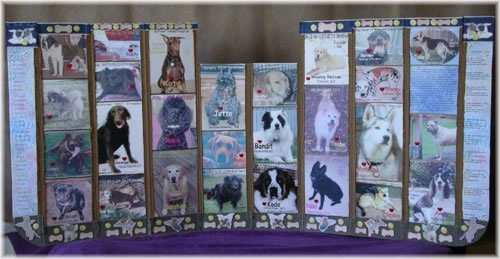
ALL Memorials:
and
"Grieving the Ungrievable"
"Adverse
drug reactions in dogs is still a little known,
misunderstood topic which needs much more public education."
~Linda Baker of AdoptingADog~
"It's Just
a Dog"
October 31, 2006 |
|
|
Product Manufacturer: Simmons
Pet Food, Inc., Siloam Springs, AR 72761
Problem/Reason for Recall:
Enamel can lining may flake off into petfood.
Distribution: Nationwide;
at Wal-Mart, Dollar General, and other retail stores.
"Use By Dates"
thru 2008
|
September
25, 2006 |
CBS4 Denver - "The
popular dog drug Deramaxx continues to generate controversy in Colorado
and across the country four years after its introduction. Some dog
owners are saying the drug has frightening side effects." |
Sept-Oct
2006 |
FDA Consumer
Magazine "It's
important for pet owners to be aware of the risks and benefits
of all drugs, including NSAIDs, so that they can make informed
decisions about their pets' health care," says Sundlof. "Owners
who give their dog NSAIDs need to know the side effects to watch
for that indicate their pet needs medical attention."
|
September
20, 2006 |
"Grassley’s
oversight of the drug-safety agency has exposed a too-cozy relationship
with the pharmaceutical drug industry and an agency culture that
has sought to suppress concerns of agency scientists about drug
safety risks." |
September 20, 2006 |
CBS4Boston: "According
to the Food and Drug Administration, more than 22,000 dogs have
gotten sick and some have died after taking non-steroidal anti-inflammatory
drugs including Metacam, Deramaxx, Previcox and Rimadyl."
|
September
16, 2006 |
|
Sept
13, 2006 |
Altoona
News: DogsDeserveBetter: |
| |
|
July
6, 2006 |
CBS 3 Philadelphia:
|
June
19, 2006 |
McCall.com:
|
June
16, 2006 |
Press
Publications: "Are
our pets being over-vaccinated?"
'Animal
Welfare: Do you know where your legislators stand?" |
June
13, 2006 |
Kansas City.com:
"....
330,000 doses of rabies vaccine sold nationwide after a vaccinated
dog got rabies."
|
| June
10, 2006 |
Charolette Observer:
Veterinarians
to notify pet owners about shots
Rabvac3
Recall " Rabvac 3 is a killed virus vaccine
for the vaccination of healthy dogs, cats and horses against
rabies."
|
June
9, 2006 |
Press
Publications: "NSAIDs: Pain killers
can be dangerous, too"
"Pet
owners can report adverse drug events"
"Do’s
and don’ts of NSAIDs"
"Courts
attach little value to pets"
"Pets
get no help from the Better Business Bureau"
Readers
Opinions |
| |
|
| June
2, 2006 |
|
May 31, 2006 |
|
May 12,
2006 |
|
May 12,
2006 |
CNN: |
April 3, 2006 |
Newsday.com:
|
March 30,
2006 |
Vet Legislation!
To help us be informed. For our companions!
Send letters, emails, make phone calls and lets get in going in
EVERY state! From the EPA: " |
February
6, 2006 |
Lawmaker
urges open disciplinary process |
January
30, 2006 |
Pet
Food Information!
|
Ongoing |
|
Ongoing |
|
| |
|
| |
|
|
|
| |
|
| |
|
 International Memorial/Survivors
How
to report a possible Vaccine Adverse Reaction
How
to report a possible Drug Adverse Reaction
How
to report a possible Flea Product
|
PLEASE NOTE: This
website, it's contents, or any reference to entities or other
links...are in no way affiliated with, sponsored by or associated
with any manufacturer, product or retail business.
We're sorry, for legal reasons we
can no longer supply product or manufacturer links.
~~~~~~~~~
PLEASE
read this Disclaimer CAREFULLY
BEFORE
USING THIS SITE
By using this site, you signify your consent to this disclaimer.
If you do not agree to this disclaimer, please DO Not use the
site.
~~~~~~~~~
Message from Web Creators: Since this site
is information and opinions only, we authorize anyone to forward
it, print it or link to it giving credit to the source.
~~~~~~~~~
ALL
stories welcome! good or bad, please !
~~~~~~~~~
|
:
on 'organization: 1 a : the act or process
of organizing or of being organized b : the condition
or manner of being organized
2 a : ASSOCIATION, SOCIETY <charitable organizations>
b : an administrative and functional structure (as a business
or a political party); also : the personnel of such a
structure
|
~~~~~~~~~~~~~~~~~~~~~~~~~~~~~~~~~~~~~~~
The Humane Society
of United States
"Anyone who wants our political and
legal systems to become more animal-friendly can make a valuable
contribution simply by learning how to become a citizen lobbyist.
If your vision of a lobbyist is a slickly dressed, smooth-talking
hired gun, get ready for a surprise. The most effective lobbyist
is the determined, engaged, and tenacious volunteer armed with
some simple facts about legislation. You need not live in Washington,
D.C. to be a lobbyist, nor do you need to be an expert on legislation.
You simply need to care about helping animals, have a spare minute
or two, and learn some basics on grassroots lobbying. The HSUS
is pleased to offer the following helpful tools on becoming a
humane legislation advocate."
~~~~~~~~~~~~~~~~~~~~~~~~~~~~~~~~~~~~~~~
"Shock
to the System" by
Catherine O'Driscoll
AVAILABLE! Sequel to "What Vets Don't Tell You About
Vaccines"
~~~~~~~~~~~~~~~~~~~~~~~~~~~~~~~~~~~~~~~
The
Animal RescueSite is having trouble getting enough people to
click on it daily to meet their quota of getting free food donated
every day to abused and neglected animals.
It takes less than a minute to go to their site and click on
"feed an animal in need" for free. This doesn't cost
you a thing. Their corporate sponsors/advertisers use th numbers
of daily visits to donate food to abandoned/neglected animals
in exchange for advertising.
Please go there now........ and send it to everyone you know
~~~~~~~~~~~~~~~~~~~~~~~~~~~~~~~~~~~~~~~
The
great aim of education is not knowledge, but action"
Herbert Spencer~
English Philosopher
~~~~~~~~~~~~~~~~~~~~~~~~~~~~~~~~~~~~~~~
"Others,
of course, will simply trust the experts who - it must
be said - tend to treat dog owners like mushrooms: keeping
us in the dark and throwing manure at us from time to
time."
Taken
from "What Vets don't Tell You About Vaccines"
by Catherine O'Driscoll and posted here with permission.
Also the author of "Shock
to the System" (sequel) and "Science
of Vaccine Damage." |
|
This new online quiz sponsored by the Humane Society
of the United States determines animal conscientiousness.
~~~~~~~~~
For a true
story on Hope.... please read the by
Meridith Moore
~~~~~~~~~
ASPCA Animal
Poison Control Center .
The Poison Control Hotline is there
to assist vets in dealing with adverse drug reactions and other
poisonings.
~~~~~~~~~
Any
and all communication is considered private, and
all transmissions become the property of DOGS & DogsAdverseReactions.
~~~~~~~~~
Media
Inquiries Welcome!
~~~~~~~~~
|
"NEVER
DOUBT THAT A SMALL GROUP OF THOUGHTFUL COMMITTED CITIZENS CAN
CHANGE THE WORLD: INDEED IT'S THE ONLY THING THAT EVER HAS."
~Margaret Mead~ |
|
"All
truth passes through three stages:
First, it is Ridiculed.
Second, it is Violently Opposed.
Third, it is Accepted as being Self-Evident."
~Arthur Schopenhauer ()
|
To translate this page
to a different language, select your preferred language below;
the text of our site will be translated by the AltaVista Babel
translation engine. Currently, we support English, French, German,
Italian, Portuguese and Spanish. We have discovered that while
the translations may not be perfect, they are generally sufficient
to convey the page's contents.
|
Many thanks to our
visitors for leaving
pawprints to this
page - since 3/8/04
|
Last update 11/27/06
|
All contents Copywrite (C) |